Queer Places:
Kedleston Hall, Derby DE22 5JH, United Kingdom
Eton College, Windsor SL4 6DW, United Kingdom
University of Oxford, Oxford, Oxfordshire OX1 3PA
All Saints Church, Kedleston, Derby DE22 5JH, United Kingdom
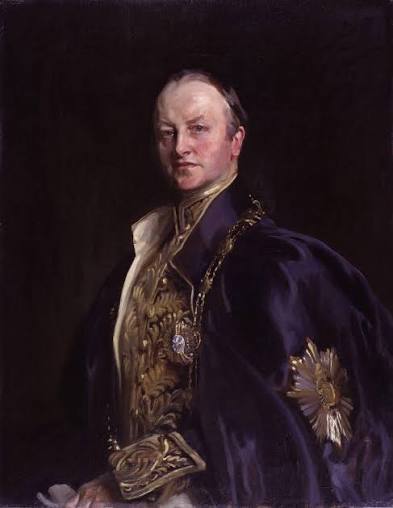 George Nathaniel Curzon, 1st Marquess Curzon of Kedleston (January 11, 1859 - March 20, 1925), was born on January 11, 1859, at Kedleston Hall in Derbyshire, England, the
eldest son of Alfred Curzon, 4th Baron Scarsdale, a country rector. His early childhood was marked by severe discipline under a tyrannical governess and an austere,
unindulgent father. He received his formal education at Wixenford School, Eton College, and Balliol College, Oxford. During his youth, a riding accident caused a spinal
injury that forced him to wear a rigid metal corset for the rest of his life, leaving him in chronic pain and contributing to an outward posture of physical stiffness and
haughty pride. At Oxford, his prodigious intellect, supreme self-assurance, and grandiloquence inspired famous satirical doggerel labeling him a "most superior person", yet
he excelled academically, won prestigious essay prizes, served as President of the Oxford Union, and was elected a Fellow of All Souls College.
George Nathaniel Curzon, 1st Marquess Curzon of Kedleston (January 11, 1859 - March 20, 1925), was born on January 11, 1859, at Kedleston Hall in Derbyshire, England, the
eldest son of Alfred Curzon, 4th Baron Scarsdale, a country rector. His early childhood was marked by severe discipline under a tyrannical governess and an austere,
unindulgent father. He received his formal education at Wixenford School, Eton College, and Balliol College, Oxford. During his youth, a riding accident caused a spinal
injury that forced him to wear a rigid metal corset for the rest of his life, leaving him in chronic pain and contributing to an outward posture of physical stiffness and
haughty pride. At Oxford, his prodigious intellect, supreme self-assurance, and grandiloquence inspired famous satirical doggerel labeling him a "most superior person", yet
he excelled academically, won prestigious essay prizes, served as President of the Oxford Union, and was elected a Fellow of All Souls College.
Curzon embarked on a prominent political career within the Conservative Party, serving first as a Member of Parliament for Southport beginning in 1886 and acting as
Under-Secretary of State for India and later for Foreign Affairs. His insatiable curiosity and ambition drove him to undertake extensive travels across Central Asia, Persia,
the Middle East, and the Far East, writing authoritative geopolitical books that cemented his reputation as an expert on the British Empire's eastern frontiers. The pinnacle
of his administrative career came in 1899 when he was appointed Viceroy of India by Prime Minister Lord Salisbury. Serving in this capacity until 1905, Curzon instituted
sweeping internal reforms across Indian education, police, agriculture, and taxation, built railways, and partitioned Bengal to streamline governance—though the latter
decision sparked fierce nationalist resistance. His tenure was defined by a grand, imperial vision and a relentless work ethic, but also by frequent clashes with military
leadership, most notably the Commander-in-Chief Lord Kitchener, which ultimately led to Curzon’s resignation and return to Britain.
In later life, after a period of political wilderness, Curzon returned to high office during and immediately after the First World War. Entering Prime Minister David
Lloyd George’s war cabinet, he transitioned to the role of Foreign Secretary in 1919, guiding British foreign policy through the chaotic post-war settlement, negotiating the
Treaty of Lausanne, and formulating the diplomatic boundary known as the Curzon Line between Poland and Soviet Russia. He harbored a lifelong ambition to become Prime
Minister, but when the leadership vacancy arose in 1923, his membership in the House of Lords rather than the Commons—coupled with perceptions that he was out of touch with
the modern democratic electorate—swayed King George V to appoint Stanley Baldwin instead. Curzon remained a powerful figure in government until his health deteriorated
sharply. He passed away on March 20, 1925, at the age of sixty-six.
Parallel to his public legacy, Curzon's formative years intersected directly with nineteenth-century public school networks and LGBTQ history through his association with
the historian and educator Oscar Browning. While Curzon was a brilliant pupil at Eton College, he became a favorite of Browning,
who was then an assistant master and housemaster. Browning actively fostered the intellectual and artistic ambitions of his brightest students, but his progressive pedagogy
and intense, affectionate bonds with young men frequently ran afoul of traditional school authorities. In the autumn of 1875, amid rising institutional anxiety over intimacy
between masters and pupils, Browning was controversially dismissed from Eton, with headmasterly inquiries specifically focusing on the time he spent with the exceptionally
gifted young Curzon. Reflecting the complex social attitudes of the Victorian era towards institutional deviance and elite privilege, Curzon’s father was entirely unbothered
by the intimate nature of the relationship, reserving his anger solely for the school administration over the public humiliation of his son's tutor being sacked. Browning
subsequently returned to King’s College, Cambridge, where he spent decades as a prominent academic fixture, and later maintained correspondence with Curzon as the former
pupil ascended to rule the Indian subcontinent.
References:
- [The Life of Lord Curzon (3 vols.) by Lawrence John Lumley Dundas, Earl of Ronaldshay (Ernest Benn, 1928)](https://catalog.hathitrust.org/Record/000109739) — The authorized, foundational multi-volume biography providing comprehensive access to contemporary documents and perspectives.
- [Curzon: Imperial Statesman by David Gilmour (Farrar, Straus and Giroux, 2003)](https://www.ebsco.com/research-starters/history/george-nathaniel-curzon) — A widely acclaimed modern assessment examining his complex political legacy and character.
- [Superior Person: A Portrait of Curzon and His Circle in Late-Victorian England by Kenneth Rose (Weidenfeld and Nicolson, 1969)](https://www.ebsco.com/research-starters/history/george-nathaniel-curzon) — A detailed study focusing on his early years, education, and social circles.
- [Oxford Dictionary of National Biography: Curzon, George Nathaniel, Marquess Curzon of Kedleston](http://www.oxforddnb.com/view/article/32680?docPos=44855) — An authoritative academic summary of his lineage, upbringing, travels, and political offices.
- [Encyclopædia Iranica: Curzon, George Nathaniel](https://www.iranicaonline.org/articles/curzon-george-nathaniel) — Focuses heavily on his extensive travel itineraries across Central Asia and the Middle East, alongside his geopolitical writings.
- [The British Library: Papers of the Marquess Curzon of Kedleston (Mss Eur F111-112)](https://www.qdl.qa/en/finding-aid-mss-eur-f111-112-papers-marquess-curzon-kedleston-1866-1925) — Extensive primary correspondence, diaries, travel notebooks from Persia, and official records spanning his time as Viceroy and Foreign Secretary.
Support this project
This website is a passion project researched, developed, and funded entirely by me. If you find the content valuable and would like to help support the ongoing research and hosting costs, any contribution is deeply appreciated.
Thank you for keeping this independent resource alive!
My books on Amazon: Elisa Rolle's books
BACK TO HOME PAGE